Around $1.54 billion was raised by 60 companies through the automatic approval route, which does not require the approval of RBI or the government, while $520 million was raised by the Exim Bank under the approval route, to meet its lending requirements abroad.

Mumbai collected Rs 17,174 crore of advance taxes against Rs 7,356 crore in the same period last year. The tax authorities believe that such a staggering growth rate is a positive sign for the economy.

Interrupting a two-month streak of decline, outward foreign direct investment (FDI) rose sequentially to $1.85 billion in July over $1.07 billion in June, an increase of 73 per cent. However, it was lower than the $2.18 billion in July last year, according to the Reserve Bank of India data. Outbound FDI, expressed as financial commitment, has three components - equity, loans, and guarantees.
Industry body Confederation of Indian Industry said with the government having announced a clear road map for fiscal consolidation and non-food inflation demonstrating a secular decline, conditions are conducive for RBI to have intervened with a repo and cash reserve ratio reduction.

India Inc's initiative to adopt Industrial Training Institutes (ITIs) across the country is facing problems because of low level of cooperation on the field as well as red-tapism, industry lobby groups have claimed.
The resurgence in confidence in Indian manufacturing was borne out by many examples of Indian companies going global.

Recovery from the second wave of the pandemic in April-May is expected to be swifter as compared to the first wave in 2020, according to the Confederation of Indian Industries (CII) chief executive officers (CEOs) poll of 119 top corporate. During the second wave, the lockdowns were largely designed to limit social gatherings and impact on economic activities was restricted. This helped arrest the impact of the second wave on economic growth, according to a survey conducted by the industry lobby group Confederation of Indian Industries (CII). About 59 per cent of the CEOs polled expect the recovery in sales to be better than in the first wave for their companies, while 46 per cent of them expressed a similar trend for their respective industry sectors.

Shareholders have given approval to the appointment of Ambani scions Akash, Isha and Anant on board of Reliance Industries, the company said in a stock exchange filing.

The manufacturing sector (excluding petroleum sector) would report a 24.3 per cent PAT growth mainly on account of low raw material prices and soft interest rates, CMIE said, adding PAT of the financial and non-financial services would rise by 32.2 per cent and 20.4 per cent, respectively.

Reserve Bank of India (RBI) deputy governor M Rajeshwar Rao on Wednesday defended the central bank's decision of not allowing industrial houses to float banks, and said more deliberations are needed before RBI changes its stance on this issue agreed back in 2001. An internal working group (IWG) of the RBI had recommended allowing industrial groups into banking, but late last month the RBI said it kept on hold the two recommendations of allowing industrial houses and large non-banks to float banks. However, RBI had accepted 21 of the 33 recommendations of the group that submitted its report a year ago.

Jobs are back and India Inc is witnessing an upsurge of 15 per cent in hiring trend, thanks to the improving economic climate. However, experts say it is too early to say that the situation has returned back to 'normalcy'.

Most of the Adani Group companies fell in the morning trade on Friday and flagship Adani Enterprises tumbled 10 per cent after index provider MSCI decided to reduce the weightage of four firms in its indices following a review. Amid volatile trading in the market, seven Adani Group firms were in the negative territory while three others were in the green. Adani Enterprises plunged 10 per cent to Rs 1,734.60 per share, its lower price band on the BSE, and the company's market valuation dropped to Rs 2.14 lakh crore.
Business jets and chartered flights have been an unlikely victim of the recent corruption scandals involving India Inc.
Even as India Inc talks of increasing corporate governance norms after the Satyam scam, a study by global consultancy firm Ernst & Young has said that more than half of the companies surveyed do not take into account risk of frauds in their annual audit plans.

M&As are back on the radar for Indian companies, but with two vital changes. First, the average size of the deals are much smaller compared to the earlier years; and second, overseas acquisitions have taken a backseat.
Some companies say they will pass on the cost to customers.

Corporate India lags the rest of its Western and Asian peers by a wide margin when it comes to the presence of women on their boards, with just 17.3 per cent of the large companies having them on their key decision making bodies, an international report said on Tuesday. However, this is a near 6 percentage points improvement between 2015 -- when it was only 11.4 per cent -- and 2021, Swiss brokerage Credit Suisse said in the report, which covered over 33,000 executives from more than 3,000 companies across 46 countries, including over 1,440 firms across 12 Asia-Pacific markets. Female representation on boards of large Indian companies has increased by 5.9 percentage points from 11.4 per cent in 2015 to 17.3 per cent in 2021.
Average salary of the 100 best-paid directors is 1% of their companies' net profit.
An unstable government is the worst thing that can happen to the Indian economy grappling with the global downturn, say business leaders.

Mukesh Ambani, the patriarch of Reliance Industries (RIL), and Gautam Adani, the chairman of Adani Group of companies, have secured the top positions on the Fortune India Rich List, created in partnership with Waterfield Advisors, with respective wealth of $99.7 billion and $63.71 billion. With a wealth of $34.6 billion, the Mistry family of Shapoorji Pallonji Group holds the third position on the list, while the Poonawalla family, owners of vaccine maker Serum Institute, with a wealth of $32.9 billion, stands fourth. Stockbroker and founder of D-Mart-branded grocery stores, Radhakishan Damani, claims the fifth spot on the India Rich List with a wealth of $23.4 billion

It plans an investment Rs 20 crore.
India Inc is likely to witness a continuing surge in merger and acquisition activities after a record number of M&A deals in the first half of 2006 -- aggregating to more than $25 billion.\n\n
As India Inc steps up the gas to expand in the global arena, it faces the risk of stumbling on frauds, the levels of which were far higher compared to global levels, according to international consulting firm Ernst and Young.
The Ficci Survey for the second quarter of 2008-09, which was carried out during November and December 2008, revealed 52 per cent of companies feel that the overall economic conditions would weaken further in the coming six months. Further nearly 90 per cent of the 412 companies surveyed in the report feel that the economic situation has deteriorated over the last six months.

The private security industry expects to grow manifold in the next five years, with India Inc enhancing the protective measures after the Mumbai attacks.
"Outsourcing is also a concern and I hope it will be addressed soon," Godrej Group Chairman Adi Godrej told reporters on the sidelines of the World Economic Forum on India in Gurgaon.
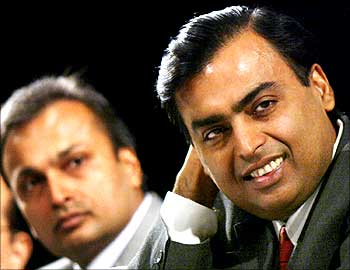
In peace and at war, firms remain tethered to promoter families in a uniquely Indian way.
Data with the Department of Industrial Policy and Promotion reveals that between April 2005 and July 2008, Japan Inc pumped in 50 per cent of the total investments inflows between April 2000 and July 2008. In fact, between June and October this year, Japanese companies said they would pump in $8 billion. Experts say this is not a knee-jerk reaction by the Japanese, who are known to be very meticulous with their investments.
India Inc said the Foreign Trade Policy would give a significant push to manufactured goods and agriculture- and labour-intensive exports.

"Lady candidates need not apply." So read the postscript in a job notice from Telco (now Tata Motors) on a notice board in the corridors of the Indian Institute of Science, Bangalore (now Bengaluru), in 1974. Irked, Sudha Murty, who was then pursuing her masters in computer science at the institute, wrote a postcard to JRD Tata, expressing her surprise at this gender discrimination, especially since the Tata Group were pioneers on many fronts. Shortly, Murty became the first woman on the firm's shop floor.

Indian companies' market capitalization has grown at the fastest pace last year among major economies despite contraction in GDP, economists from SBI said, flagging the risks to financial stability it poses. Further, retail investors have shown higher interest in markets and their numbers have increased by 1.42 crore in FY21 and another 44 lakh in April and May, they said in a note, wondering if this will be a lasting behavioural change or is transitory. The economists at the country's largest lender attributed the growth in equity markets to lower returns on other financial instruments amid a low rates regime, increase in global liquidity, and even a tendency to spend more time at home because of mobility restrictions which led many to trade more.
Corporate India is joining the AIDS battle.
